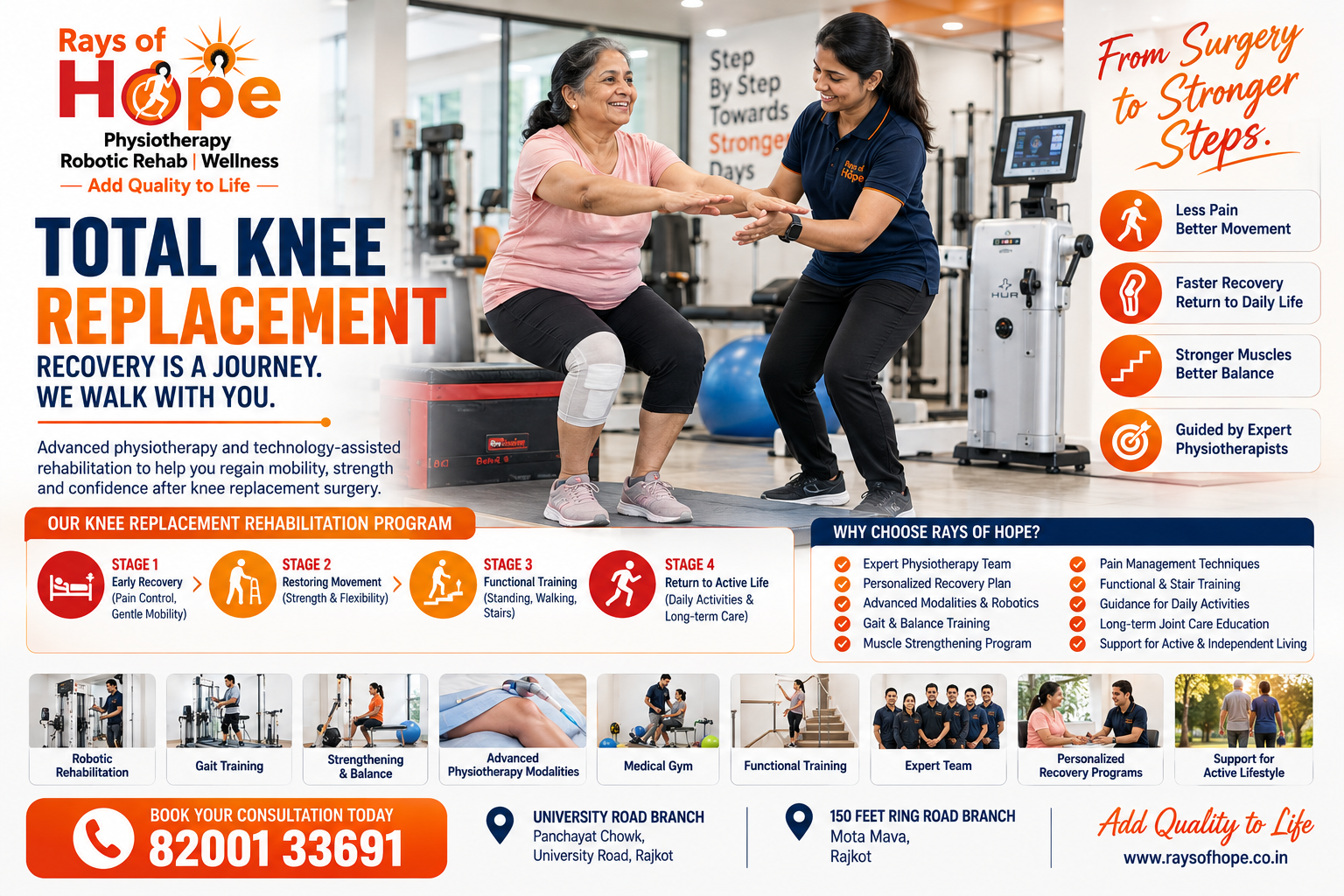
Total Knee Replacement Rehabilitation in Rajkot: A Complete Guide to TKR Physiotherapy & Recovery
Total Knee Replacement, commonly called TKR, is a major orthopedic procedure performed to reduce pain and improve function in people with severe knee joint problems.
But the operation itself is only one part of the recovery journey.
Structured rehabilitation after knee replacement plays an important role in restoring knee movement, muscle strength, walking ability, balance and confidence.
If you are looking for knee replacement rehabilitation in Rajkot or TKR physiotherapy in Rajkot, this guide explains what rehabilitation generally involves, why physiotherapy is important and how a personalized rehabilitation program can support your return to daily activities.
What Is Total Knee Replacement?
Total Knee Replacement is a surgical procedure in which damaged portions of the knee joint are replaced with artificial components.
It may be considered when severe knee arthritis or other joint damage causes persistent:
- Knee pain
- Stiffness
- Difficulty walking
- Difficulty climbing stairs
- Reduced mobility
- Difficulty performing daily activities
The decision to undergo surgery is made with an orthopedic surgeon after considering symptoms, examination findings, imaging and other treatment options.
After surgery, rehabilitation becomes an important part of the recovery process.
Why Is Physiotherapy Important After Knee Replacement?
Following TKR, patients may experience:
- Pain and swelling
- Reduced knee range of motion
- Quadriceps weakness
- Difficulty walking
- Reduced balance
- Difficulty with stairs
- Reduced confidence during movement
A supervised exercise program can help address these limitations.
The American Academy of Orthopaedic Surgeons has reported moderate evidence supporting supervised exercise during the first two months after total knee arthroplasty for improving physical function. American Academy of Orthopaedic Surgeons
The rehabilitation plan, however, should be individualized according to the patient's surgery, medical condition, pain, mobility and functional goals.
TKR Rehabilitation: What Does Physiotherapy Include?
A typical rehabilitation program may progress through several stages.
Stage 1: Early Recovery
The initial focus is on:
- Pain and swelling management
- Safe transfers
- Bed mobility
- Gentle knee movement
- Quadriceps activation
- Ankle movements
- Safe standing
- Walking with an appropriate aid
The exact exercises and progression should be determined by the treating clinical team.
Stage 2: Restoring Knee Movement
Regaining appropriate knee range of motion is an important rehabilitation goal.
Physiotherapy may include appropriately selected:
- Active knee movements
- Assisted range-of-motion exercises
- Heel slides
- Quadriceps exercises
- Hamstring and calf flexibility work
- Functional movement practice
The objective is not simply to force the knee to move.
The goal is controlled, progressive movement within the patient's appropriate postoperative plan.
Stage 3: Strengthening the Leg
After TKR, weakness of the muscles around the knee can affect walking and functional activities.
Rehabilitation may progressively target:
Quadriceps
Important for:
- Standing
- Walking
- Stair climbing
- Sit-to-stand activities
Hamstrings
Important for:
- Knee control
- Walking
- Functional movement
Gluteal muscles
Important for:
- Hip and pelvic stability
- Balance
- Walking mechanics
Exercise intensity should be progressed according to the patient's recovery and medical guidance.
Stage 4: Walking Rehabilitation
Walking is one of the major functional goals following knee replacement.
Physiotherapy may address:
- Step pattern
- Weight transfer
- Walking speed
- Symmetry
- Balance
- Use of walking aids
- Confidence during walking
As appropriate, patients may gradually progress from:
Bed → Standing → Supported Walking → Independent Walking → Functional Walking
The exact timeline differs considerably between patients.
Stage 5: Stair Training
Stair climbing can remain challenging after knee replacement.
Physiotherapists may train:
- Step-up ability
- Step-down control
- Quadriceps strength
- Balance
- Weight shifting
- Confidence
The progression should be based on the patient's strength, range of motion and safety.
Stage 6: Functional Rehabilitation
The final goal of rehabilitation is not simply achieving a certain knee angle.
It is helping the patient return to meaningful daily activities.
Functional rehabilitation may include:
- Sit-to-stand
- Walking outdoors
- Stairs
- Getting in and out of a chair
- Household activities
- Balance training
- Lower-limb strengthening
- Endurance training
- Activity-specific exercises
How Long Does TKR Rehabilitation Take?
There is no single recovery timeline that applies to everyone.
Recovery can be influenced by:
- Age
- Preoperative muscle strength
- Overall fitness
- Other medical conditions
- Surgical procedure
- Pain and swelling
- Knee range of motion
- Balance
- Previous mobility
- Adherence to the rehabilitation program
Some patients progress quickly, while others require a longer rehabilitation period.
Therefore, rather than following an internet-based fixed timeline, rehabilitation should be assessment-based and progressively adjusted.
Can Advanced Physiotherapy Help After Knee Replacement?
Modern rehabilitation can combine conventional physiotherapy with appropriate technology-assisted treatments.
Depending on the patient's condition and rehabilitation goals, a centre may use:
- Therapeutic exercise
- Strength training
- Balance training
- Gait training
- Functional training
- Manual therapy where appropriate
- Electrotherapy
- Advanced rehabilitation equipment
- Robotic rehabilitation for selected functional goals
- Aqua therapy when medically appropriate
Technology should complement—not replace—clinical assessment and physiotherapy.
Aqua Therapy After Knee Replacement
Aquatic rehabilitation can be considered for selected patients once the surgical wound has appropriately healed and the treating medical team considers aquatic exercise safe.
Water can provide buoyancy and a different environment for practising movement and exercise.
At Rays of Hope, the current website describes Aqua Therapy & Aquatic Rehabilitation for selected post-surgical rehabilitation, including total knee replacement. Rays of Hope
The timing of pool-based rehabilitation should always be determined individually.
What Exercises Are Commonly Used After TKR?
Depending on the stage of recovery, a physiotherapist may prescribe exercises such as:
Early phase
- Ankle pumps
- Quadriceps activation
- Gentle knee range-of-motion exercises
- Heel slides
- Straight-leg exercises when appropriate
Progressive phase
- Sit-to-stand
- Supported squats
- Step exercises
- Resistance exercises
- Balance training
- Walking practice
Later phase
- Progressive strengthening
- Endurance training
- Functional exercises
- Stair training
- Activity-specific conditioning
Do not copy a postoperative exercise program from the internet without discussing it with your surgeon or physiotherapist.
AAOS patient guidance similarly recommends that exercise programs after surgery be selected with the treating doctor or physical therapist and advises seeking professional guidance if an exercise causes pain. OrthoInfo
When Should You Contact Your Doctor?
After knee replacement, patients should follow the postoperative instructions provided by their surgical team.
Seek appropriate medical assessment for concerning symptoms such as:
- Increasing rather than improving pain
- Significant or rapidly increasing swelling
- Fever
- Wound problems
- Redness or drainage from the surgical area
- Sudden calf swelling or pain
- Chest pain or unexplained breathing difficulty
- Sudden inability to bear weight
These symptoms should not simply be treated as routine physiotherapy discomfort.
TKR Physiotherapy at Rays of Hope, Rajkot
At Rays of Hope Physiotherapy, Robotic Rehabilitation & Wellness Center, postoperative rehabilitation can be structured around the patient's individual functional goals.
The approach can include:
Assessment
Understanding pain, mobility, strength, range of motion, balance and walking ability.
Personalized Rehabilitation
Developing a progressive rehabilitation plan based on the patient's needs.
Strength & Mobility Training
Working on the muscles and movements required for everyday function.
Gait & Balance Training
Progressively improving walking confidence and functional mobility.
Advanced Rehabilitation
Using appropriate technology and modalities when clinically indicated.
Functional Training
Practising activities such as standing, walking, stairs and daily movement.
Long-Term Guidance
Helping patients understand exercise, activity progression and ongoing joint care.
Rays of Hope's website currently describes post-operative physiotherapy, orthopedic rehabilitation, mobility and strength recovery as part of its services. Rays of Hope
Why Choose a Structured Rehabilitation Program After TKR?
A good rehabilitation program should focus on more than reducing pain.
The bigger objective is:
Pain Management → Mobility → Strength → Balance → Walking → Function → Independence
Every patient has different requirements.
The right program therefore depends on assessment rather than a one-size-fits-all protocol.
Total Knee Replacement Rehabilitation in Rajkot
If you or a family member has recently undergone Total Knee Replacement and is looking for physiotherapy and rehabilitation in Rajkot, professional assessment can help determine the appropriate rehabilitation pathway.
Rays of Hope Physiotherapy, Robotic Rehabilitation & Wellness Center
📍 University Road Branch
Panchayat Chowk, University Road, Rajkot
📍 150 Feet Ring Road Branch
Mota Mava, Rajkot
📞 +91 82001 33691
🌐 Rays of Hope Official Website
Final Takeaway
Total Knee Replacement is not the end of the treatment journey—it is the beginning of a structured rehabilitation process.
With appropriate postoperative guidance, progressive exercise, strength training, mobility work, balance training and functional rehabilitation, patients can work toward regaining movement and returning to their daily activities.
Remember:
Surgery replaces the damaged joint.
Rehabilitation helps you learn to use it again.
Rays of Hope — Add Quality to Life.
🔎 SEO PACK — READY FOR YOUR WEBSITE
SEO Title:
Knee Replacement Rehabilitation in Rajkot | TKR Physiotherapy
Meta Description:
Learn about knee replacement rehabilitation in Rajkot, including TKR physiotherapy, exercises, walking, strengthening, balance training and recovery after total knee replacement.
Primary Keyword:
knee replacement rehabilitation rajkot
Secondary Keywords:
TKR physiotherapy rajkot, knee replacement physiotherapy rajkot, joint replacement rehabilitation rajkot, physiotherapy after knee replacement, TKR rehabilitation exercises
URL:
/knee-replacement-rehabilitation-rajkot/
Featured Image Alt Text:
Total Knee Replacement Rehabilitation and TKR Physiotherapy at Rays of Hope Rajkot
Suggested Tags:
Knee Replacement, TKR Physiotherapy, Knee Rehabilitation, Orthopedic Rehabilitation, Physiotherapy Rajkot, Joint Replacement, Post Operative Rehabilitation
Internal links to add
Link this blog naturally to your existing:
- Knee Pain Physiotherapy
- Orthopedic Rehabilitation
- Robotic Rehabilitation
- Aqua Therapy
- Physiotherapy in Rajkot
- Post-operative Rehabilitation
This topic is particularly useful because “knee replacement rehabilitation rajkot” and “TKR physiotherapy rajkot” are already P1 keywords in your uploaded master list, while your existing content is more focused on general knee pain. It therefore creates a distinct postoperative-rehabilitation search-intent page rather than cannibalizing your existing Types of Knee Pain article.