Best Robotic Rehabilitation Centre in Rajkot: Advanced Robotic Physiotherapy & Neuro Rehabilitation at Rays of Hope
When conventional physiotherapy alone is not enough for a patient with significant weakness, impaired walking, poor balance or reduced hand function, modern rehabilitation technology can provide additional opportunities for high-repetition, task-specific and measurable training.
Robotic rehabilitation has become an important part of contemporary neuro and functional rehabilitation. Robotic systems can assist therapists in delivering controlled, repetitive movement training while adjusting the amount of assistance or resistance according to the patient's abilities.
In Rajkot, Rays of Hope Physiotherapy, Robotic Rehabilitation & Wellness Center has developed a dedicated technology-assisted rehabilitation program combining advanced robotics with physiotherapy and multidisciplinary rehabilitation.
Why Is Robotic Rehabilitation Important?
One of the fundamental principles of neurological rehabilitation is repetitive, task-specific practice.
Patients recovering from conditions such as stroke, spinal cord injury or traumatic brain injury may have difficulty performing movements independently.
Robotic systems can provide graded assistance so that appropriate movement can be practised repeatedly in a controlled environment.
Mission Health's robotics overview similarly highlights increased therapy intensity, repetitive physiological movement, adjustable assistance and objective performance monitoring as potential advantages of rehabilitation robotics. Mission Health
At Rays of Hope, robotic technology is integrated with physiotherapy rather than being used as a replacement for the therapist.
Rays of Hope: Advanced Robotic Rehabilitation in Rajkot
The current Rays of Hope robotics service page lists a broad range of technology-assisted rehabilitation systems, including:
- Robotic Neuro Modulation
- Exoskeleton-assisted gait training
- Arm Robotics
- Hand Robot
- Wrist & Finger Robot
- Foot Robot
- Robotic FES
- Syrebo A2 Hand Robotic System
- RYMO Robotic Rehabilitation
- Balance Training Robot
- Unweighting Robot
- Tilt Table Therapy
- Active-Passive Training
- Robotic Posture & Foot Scan
- Virtual Reality / gaming-based rehabilitation Rays of Hope
This breadth allows robotic rehabilitation to address different aspects of movement rather than focusing exclusively on walking.
1. Robotic Gait & Walking Rehabilitation
Walking recovery is one of the major goals for many neurological rehabilitation patients.
Robotic and unweighting systems can assist with:
- Repetitive walking practice
- Weight shifting
- Lower-limb movement
- Gait pattern training
- Balance
- Endurance
- Functional mobility
Rays of Hope's unweighting robot program describes partial body-weight support, progressive walking practice, balance training and gait re-education. Rays of Hope
Who may benefit?
Selected patients with:
- Stroke
- Spinal cord injury
- Parkinson's disease
- Cerebral palsy
- Lower-limb weakness
- Post-surgical weakness
- Gait abnormalities
2. Exoskeleton Rehabilitation
Exoskeleton-based systems can provide mechanical assistance during walking practice.
For appropriately selected patients, this can help therapists practise:
Standing → Weight Bearing → Stepping → Walking
The amount of assistance should be determined according to the patient's clinical status and rehabilitation stage.
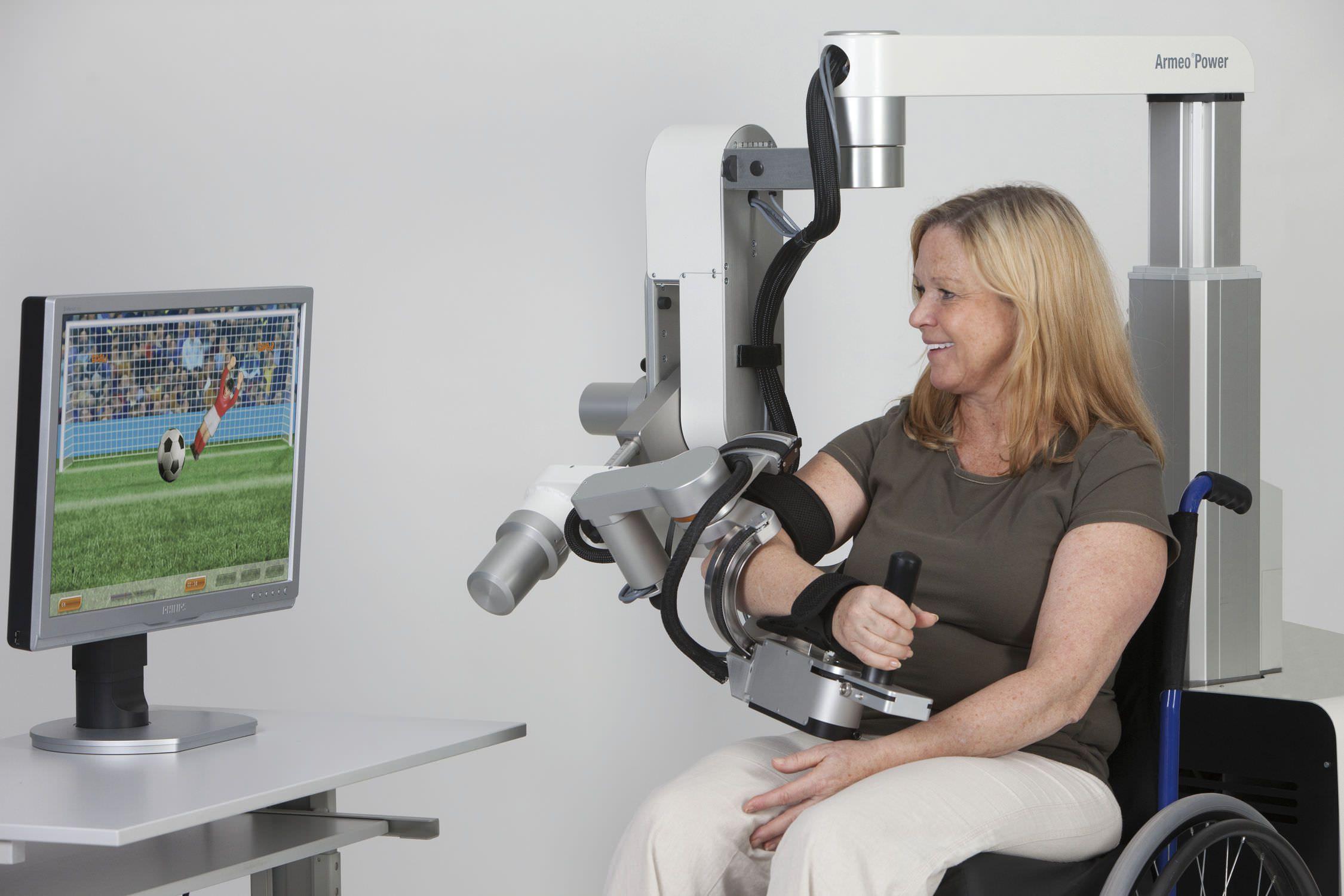
3. Upper-Limb Robotic Rehabilitation
Recovery isn't only about walking.
After stroke or neurological injury, patients may experience difficulty using:
- Shoulder
- Elbow
- Wrist
- Hand
- Fingers
Robotic upper-limb therapy can provide repetitive and controlled movement practice.
The Rays of Hope robotics program includes dedicated arm, hand, wrist and finger robotic systems. Rays of Hope
4. Robotic Hand Rehabilitation
Hand function is essential for independence.
Simple activities such as:
- Holding a cup
- Eating
- Writing
- Buttoning clothes
- Using a mobile phone
- Grooming
- Picking up objects
require coordinated hand and finger movement.
Rays of Hope's Hand Robot program is designed around repetitive, task-oriented hand rehabilitation for conditions including stroke, spinal cord injury, traumatic brain injury and peripheral nerve injuries. Rays of Hope
5. Wrist & Finger Robotic Therapy
Fine motor control can remain impaired even after a patient begins walking independently.
Dedicated wrist and finger robotic rehabilitation can provide guided repetitive movement and functional hand training.
The objective is to progressively improve:
Movement → Coordination → Strength → Dexterity → Functional Hand Use
Rays of Hope lists dedicated Wrist & Finger Robotic Therapy as part of its rehabilitation technology. Rays of Hope
6. RYMO Robotic Rehabilitation
Rays of Hope also provides RYMO Robotic Therapy, which its website describes as a robotic-assisted system for upper- and lower-limb movement, coordination and functional recovery. Rays of Hope
Programs can include:
- Upper-limb training
- Lower-limb gait training
- Task-oriented exercises
- Balance and coordination
- Progressive resistance
- Neuro-motor re-education
7. Robotic Neuro Modulation
Neurological rehabilitation increasingly focuses on the relationship between the brain, spinal cord and muscles.
Rays of Hope's Robotic Neuro Modulation service is designed to provide technology-assisted, repetitive and task-specific training as part of neurological rehabilitation. Rays of Hope
It is listed for conditions including:
- Stroke
- Spinal cord injury
- Traumatic brain injury
- Parkinson's disease
- Multiple sclerosis
- Cerebral palsy
- Neuromuscular disorders
8. Robotic FES
Functional Electrical Stimulation can be incorporated into rehabilitation for selected patients.
FES may assist muscle activation while the patient performs functional movement.
At Rays of Hope, Robotic FES is included among the advanced robotic rehabilitation technologies listed on the robotics page. Rays of Hope
9. Balance & Postural Rehabilitation
Balance problems can affect:
- Standing
- Walking
- Turning
- Stair climbing
- Transfers
- Confidence
Rays of Hope includes Balance Training Robot technology within its robotics program. Rays of Hope
Balance rehabilitation can be progressed according to the patient's abilities and goals.
10. Robotic Posture & Foot Scan
Walking isn't only about the legs.
The foot-ground interaction can provide important information about:
- Pressure distribution
- Weight bearing
- Gait
- Posture
- Alignment
- Asymmetry
Rays of Hope lists Robotic Posture & Foot Scan Analysis among its advanced technologies. Rays of Hope
This can complement clinical assessment and help therapists understand movement patterns more objectively.
11. Virtual Reality & Gaming-Based Rehabilitation
Rehabilitation can sometimes become repetitive.
Virtual reality and interactive gaming can make selected exercises more engaging while providing opportunities for:
- Balance training
- Coordination
- Upper-limb training
- Lower-limb training
- Cognitive activities
- Functional movement
Rays of Hope's robotics program specifically includes virtual-reality and gaming-based rehabilitation. Rays of Hope
What Makes a Good Robotic Rehabilitation Program?
Robotics alone does not constitute rehabilitation.
A comprehensive program should combine:
Clinical Assessment
Understanding the patient's diagnosis, impairments and goals.
Physiotherapy
Hands-on assessment and movement-based treatment.
Robotic Training
Using appropriate technology for repetitive and task-specific practice.
Functional Training
Converting improvements into real-world activities.
Home Program
Continuing appropriate exercises outside the clinic.
Progress Monitoring
Tracking meaningful functional changes.
This is why the therapist + technology combination is more important than simply counting the number of machines.
Affordable Robotic Rehabilitation: What Does "Affordable" Mean?
Advanced technology does not automatically mean that rehabilitation has to be inaccessible.
At Rays of Hope, patients can discuss their individual rehabilitation requirements and select an appropriate program based on:
- Diagnosis
- Rehabilitation goals
- Required technology
- Therapy frequency
- Functional needs
- Duration of rehabilitation
Rather than suggesting that every patient needs every machine, the goal should be:
Right Patient + Right Technology + Right Intensity + Right Rehabilitation Plan
This is a more clinically meaningful way to approach affordability.
Latest Technology With Experienced Physiotherapy
The most important component of robotic rehabilitation is not the robot itself.
It is the clinical reasoning behind its use.
A physiotherapist determines:
- Which movement needs to be trained
- How much assistance is required
- How many repetitions are appropriate
- When resistance should be increased
- When assistance should be reduced
- When the patient should transition to independent movement
Rays of Hope describes its robotic programs as individualized and goal-oriented, combining advanced technology with expert rehabilitation care. Rays of Hope