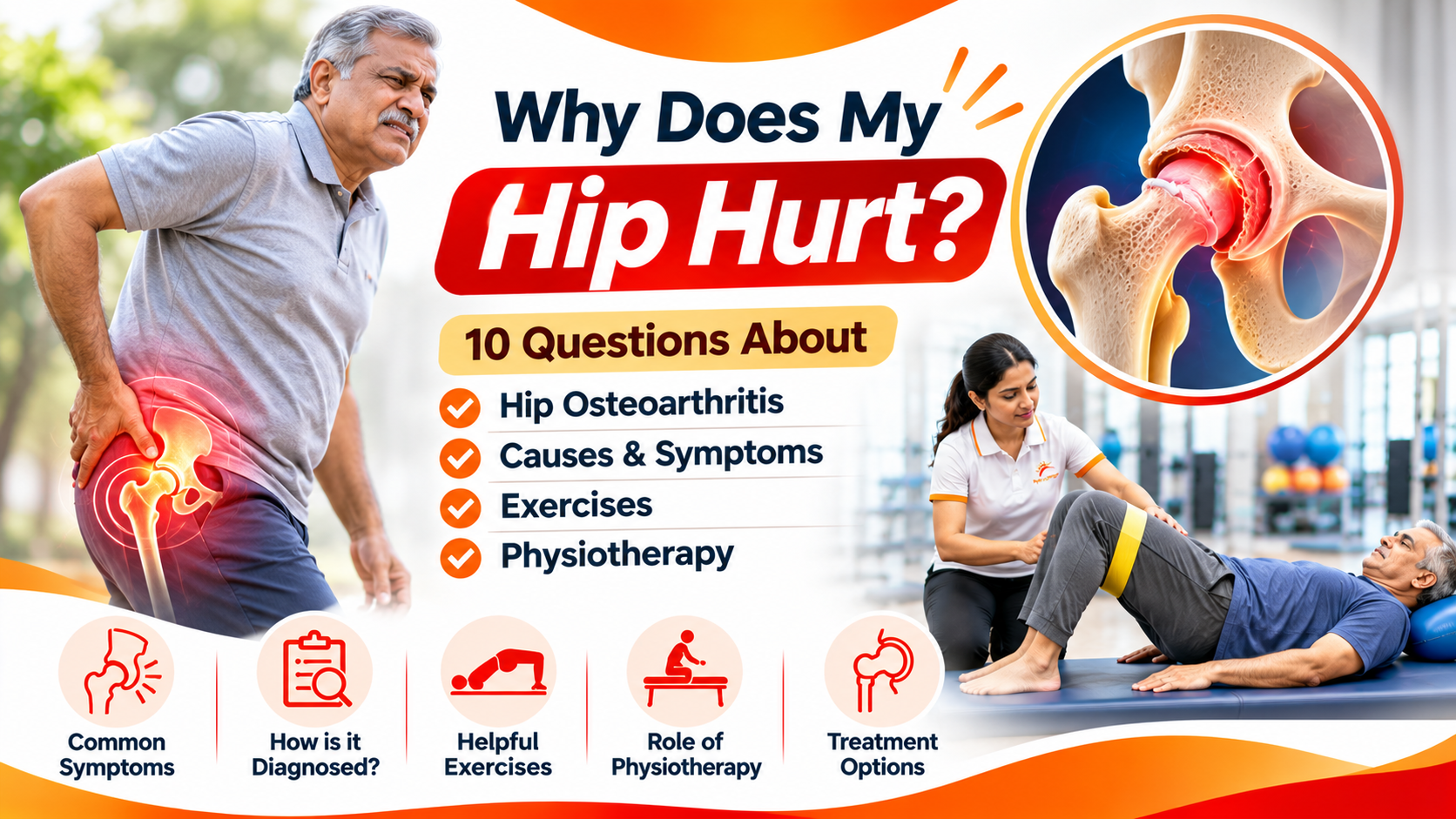
Why Does My Hip Hurt While Walking or Climbing Stairs?
Hip pain can make everyday activities difficult. You may notice discomfort while walking, climbing stairs, getting up from a chair, putting on socks, or getting in and out of a car.
One possible cause is hip osteoarthritis (hip OA), a condition involving changes in the joint cartilage and surrounding structures. However, not every hip pain is arthritis. Identifying the actual cause is important before starting treatment.
Here are 10 common questions about hip osteoarthritis, diagnosis, exercises and physiotherapy.
1. What is hip osteoarthritis?
Hip osteoarthritis is a degenerative joint condition in which the cartilage and other joint structures gradually change. The hip joint may become painful and stiff, and movement can become restricted.
The hip is a ball-and-socket joint. It allows us to walk, sit, stand, climb stairs and rotate the leg.
As osteoarthritis develops, some people experience:
Pain around the groin or front of the hip.
Stiffness after sitting or resting.
Difficulty walking for longer distances.
Reduced hip rotation and flexibility.
Difficulty wearing socks or footwear.
The severity of symptoms does not always correspond directly to the amount of change seen on an X-ray.
2. What are the common symptoms of hip arthritis?
Symptoms may develop gradually and become more noticeable during daily activities.
Common symptoms include:
Groin pain while walking.
Pain when standing after prolonged sitting.
Stiffness, particularly after periods of inactivity.
Difficulty climbing stairs or getting into a vehicle.
Reduced ability to bend or rotate the hip.
Limping or changes in walking pattern.
Pain that may sometimes be felt in the thigh or knee.
Persistent symptoms that affect sleep or normal activities should be assessed by a healthcare professional.
3. What causes hip osteoarthritis?
Hip osteoarthritis can develop due to several contributing factors.
Common risk factors include:
Increasing age.
Previous hip injury or fracture.
Previous joint infection or inflammatory joint disease.
Developmental hip conditions, such as hip dysplasia.
Previous structural abnormalities of the hip.
Excess body weight, which may contribute to joint loading.
Family history and genetic susceptibility.
Sometimes, hip osteoarthritis develops without one clearly identifiable cause.
4. Is all hip pain caused by arthritis?
No. Hip pain can originate from different structures, and the location of pain can provide useful clues.
| Possible condition | Common presentation |
|---|---|
| Hip osteoarthritis | Groin pain, stiffness and restricted hip movement |
| Greater trochanteric pain syndrome | Pain over the outer side of the hip, often when lying on that side |
| Lumbar radiculopathy | Back or buttock pain radiating into the leg |
| Hip flexor-related pain | Discomfort in the front of the hip during certain movements |
| Femoral head avascular necrosis (AVN) | Deep groin pain, sometimes with weight-bearing difficulty |
| Hip fracture | Sudden pain, often after trauma or a fall |
A clinical assessment is important because these conditions require different management approaches.
5. How is hip osteoarthritis diagnosed?
Diagnosis generally involves a combination of medical history and physical examination.
A physiotherapist or doctor may assess:
Location and duration of pain.
Walking pattern and functional limitations.
Hip range of motion, particularly internal rotation.
Muscle strength and flexibility.
Pain during specific movements.
Lumbar spine and surrounding joint function.
An X-ray may be advised when clinically indicated. MRI is not routinely required for every person with suspected hip osteoarthritis, but may be useful when another diagnosis is suspected or symptoms need further investigation.
6. Can physiotherapy help hip osteoarthritis?
Yes. Exercise-based physiotherapy is an important part of non-surgical management for many people with hip osteoarthritis.
A structured rehabilitation programme may help improve:
Hip muscle strength.
Joint mobility and movement confidence.
Walking capacity.
Balance and functional stability.
Ability to perform daily activities.
Pain management and physical fitness.
The programme should be individualised according to symptoms, mobility, strength, age, general health and functional goals.
7. Which exercises are useful for hip osteoarthritis?
The choice of exercise depends on the individual's pain level, mobility and clinical findings.
A physiotherapist may consider exercises such as:
Denver Physical Therapy at Home – Supine Exercises - Denver Physical Therapy at Home
Träning efter höftoperation - 1177
4
Examples include:
Glute bridge: To strengthen the gluteal muscles.
Seated hip abduction: To strengthen the hip abductors.
Supported hip extension: To improve posterior hip muscle strength.
Sit-to-stand practice: To improve functional lower-limb strength.
Gentle hip mobility exercises: To maintain comfortable available movement.
Walking or cycling: To improve general fitness, when tolerated.
Start with an appropriate level and progress gradually. Exercises should not cause severe or persistent worsening of symptoms. Avoid forcing painful hip movements.
8. Is walking or swimming good for hip arthritis?
Appropriately dosed physical activity is generally encouraged.
Depending on the individual's tolerance, options may include:
Short, regular walks.
Stationary cycling.
Swimming.
Aquatic physiotherapy.
Low-impact strengthening exercises.
Aquatic exercise can be useful for some people because water provides support and reduces the amount of weight-bearing load during movement.
The right activity and intensity depend on the person's symptoms and physical capacity.
9. Can hip arthritis be treated without surgery?
Many people with mild to moderate symptomatic hip osteoarthritis can be managed initially without surgery.
A non-surgical management plan may include:
Individualised therapeutic exercise.
Physiotherapy and functional rehabilitation.
Weight management where appropriate.
Activity modification.
Education about joint protection and symptom management.
Medical advice regarding suitable pain-relief options.
However, if pain, stiffness and functional limitations significantly affect quality of life despite appropriate non-surgical care, an orthopaedic consultation for possible hip replacement may be appropriate.
Physiotherapy can also play an important role before and after hip replacement surgery.
10. When should I consult a physiotherapist or orthopaedic specialist?
Do not ignore persistent hip pain, particularly if it is affecting walking, sleep or daily activities.
Seek an assessment if you experience:
Persistent groin or hip pain.
Progressive difficulty walking.
Reduced hip movement.
Repeated limping.
Pain that interferes with sleep or daily activities.
Urgent medical assessment
Seek urgent care for sudden severe hip pain, a hot or swollen hip with fever, severe pain following a fall, or inability to stand or bear weight after an injury. These symptoms may indicate a condition other than routine osteoarthritis.
How can physiotherapy help at Rays of Hope, Rajkot?
At Rays of Hope Physiotherapy, Robotic Rehabilitation & Wellness Center, rehabilitation is planned according to the patient's clinical assessment, mobility and functional goals.
Our rehabilitation services include:
Musculoskeletal and orthopaedic physiotherapy.
Individualised hip mobility and strengthening programmes.
Gait and balance training.
Functional rehabilitation.
Aquatic therapy, where appropriate.
Medical gym and supervised exercise programmes.
Pre-operative and post-operative rehabilitation.
Our goal is to help patients improve movement, maintain independence and add quality to life.
Visit Rays of Hope, Rajkot
University Road Branch
Near Khodiyar Dairy, Panchayat Chowk, University Road, Rajkot.
Mota Mava Branch
Opp. Sunshine School, Behind Karan Arjun Party Plot, New 150 Feet Ring Road, Rajkot.
Contact: +91 82001 33691
Website: www.raysofhope.co.in
Consultation and treatment recommendations are based on individual clinical assessment.