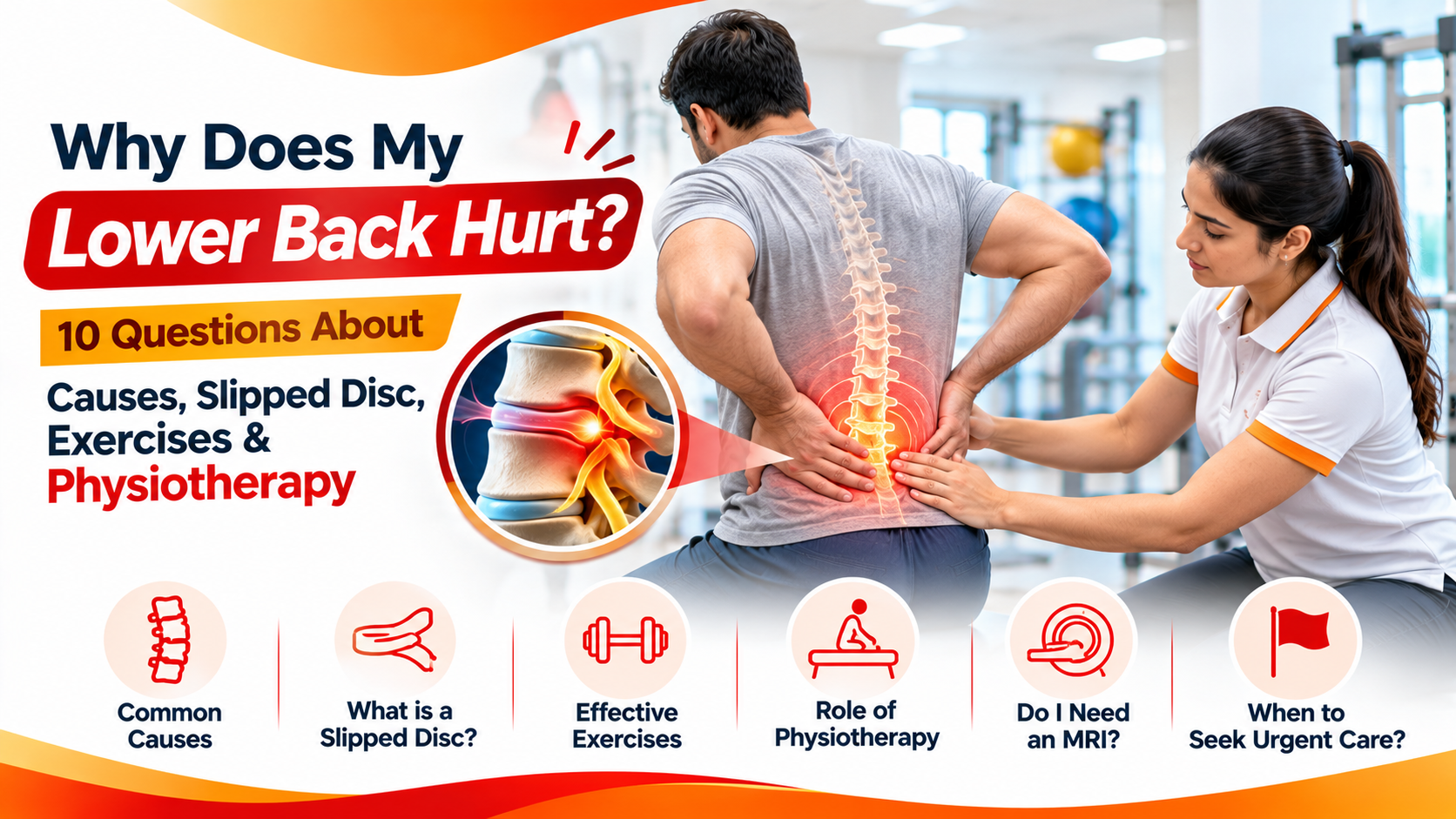
Why Does My Lower Back Hurt?
Lower back pain is one of the most common reasons people seek medical advice and physiotherapy. It can affect your ability to sit, stand, bend, walk, sleep, work or enjoy everyday activities.
Some people experience pain after lifting a heavy object. Others notice discomfort after long hours of sitting, bending repeatedly or getting out of bed in the morning. In some cases, pain may travel from the lower back into the buttock or leg.
But does every episode of back pain mean you have a slipped disc? Do you need an MRI? Can physiotherapy help?
Let’s answer 10 important questions about lower back pain and its management.
1. What are the common causes of lower back pain?
Lower back pain can arise from several structures, including muscles, ligaments, joints, intervertebral discs and nerves.
Common contributing factors include:
Muscle or ligament strain.
Prolonged or repetitive physical loading.
Reduced physical activity and deconditioning.
Disc-related conditions.
Lumbar joint or degenerative changes.
Poorly tolerated lifting or bending activities.
Certain inflammatory or medical conditions.
In many people, no single structural cause can be identified. This is often described as non-specific low back pain.
Lower back pain is extremely common worldwide. The World Health Organization estimated that 619 million people experienced low back pain in 2020.
World Health Organization+1
2. Does lower back pain always mean I have a slipped disc?
No. A slipped disc, more accurately called a disc herniation, is only one possible cause of lower back pain.
The intervertebral discs sit between the bones of the spine and help distribute loads. A disc may develop a bulge or herniation, which sometimes irritates a nearby nerve.
Possible symptoms include:
Lower back pain.
Pain spreading into the buttock or leg.
Tingling or numbness in the leg or foot.
In some cases, muscle weakness.
However, disc bulges and degenerative changes can also appear on MRI scans in people who have no pain.
An MRI finding should always be interpreted alongside the patient's symptoms and clinical examination.
PMC+1
3. Why does my back hurt after sitting for a long time?
Prolonged sitting may aggravate symptoms in some people, particularly when they remain in one position for extended periods without movement.
You may experience:
Stiffness when standing up.
Discomfort after working at a desk.
Pain while travelling.
Difficulty straightening your back immediately after sitting.
There is no single perfect sitting posture for everyone. Instead, try to vary your position, take movement breaks and adjust your workstation to a comfortable height.
If sitting repeatedly triggers significant pain, a physiotherapist can assess your movement patterns and activity tolerance.
4. Why does lower back pain sometimes travel into the leg?
Pain travelling from the lower back into the buttock or leg may indicate nerve irritation, commonly called sciatica when the sciatic nerve distribution is involved.
Possible associated symptoms include:
Pain extending down one leg.
Tingling or pins and needles.
Numbness in part of the leg or foot.
Weakness in certain leg or foot movements.
Not all leg pain originates from the spine. Hip conditions, peripheral nerve problems and other medical conditions can also cause similar symptoms.
A neurological and musculoskeletal examination helps determine the likely source.
5. Do I need an MRI or X-ray for lower back pain?
Not necessarily.
Many people with uncomplicated lower back pain do not need immediate imaging. Imaging is generally considered when there are warning signs, suspected serious pathology, progressive neurological deficits or when the findings are likely to change treatment decisions.
A clinician may recommend further investigation based on:
Significant trauma.
Suspected fracture.
History of cancer.
Possible infection.
Progressive neurological weakness.
Symptoms suggesting serious nerve compression.
An MRI should not be ordered simply because back pain is present. The decision should follow a clinical assessment.
NICE+1
6. Can physiotherapy help lower back pain?
Yes. Physiotherapy can play an important role in managing many types of lower back pain.
An individualised programme may include:
Assessment of spinal and hip movement.
Advice on staying active and modifying aggravating activities.
Progressive strengthening exercises.
Trunk endurance and motor-control training.
Mobility exercises where appropriate.
Graded return to work, sports and daily activities.
Education about pain, recovery and self-management.
For persistent low back pain, exercise-based and multidisciplinary approaches may be appropriate. The World Health Organization recommends structured exercise as one of the non-surgical options for chronic primary low back pain.
World Health Organization+1
Treatment should be based on the individual's assessment, goals and response rather than a fixed package of exercises.
7. Which exercises may help lower back pain?
The most appropriate exercises depend on the cause of symptoms, physical capacity and clinical assessment.
A physiotherapist may consider:
«Наклон таза» Поясничное сгибание/разгибание AROM, лежа на спине
Pelvic tilts: Gentle pelvic movement to improve awareness and control of the lower trunk.
הַפיסְפוּס הַגָּדוֹל בַּטִּפּוּל בִּכְאֵבֵי גַּב ❌ | פיזיוקליק
Glute bridges: To develop hip and trunk strength.
دورات العلاج الطبيعي مجانية عبر الإنترنت — شهادة ووصول مدى الحياة [2026] | Elevify
Bird-dog exercise: To train trunk control and coordination.
Understanding Lower Back Pain: Causes, Treatment, and Recovery Tips
Cat-cow movement: To explore comfortable spinal mobility.
These are examples, not a universal prescription. Stop an exercise if it causes significant worsening, new leg symptoms, numbness or weakness, and seek professional guidance.
8. Should I rest completely when my back hurts?
Usually, prolonged bed rest is not recommended for uncomplicated lower back pain.
Depending on your symptoms, you may be advised to:
Continue gentle daily activities as tolerated.
Take short movement breaks.
Avoid temporarily aggravating activities.
Gradually return to normal work and exercise.
Follow a progressive rehabilitation plan.
The goal is not to force painful movements, but to avoid unnecessary inactivity and rebuild confidence in movement. NICE recommends advice and support for self-management, including encouragement to continue normal activities.
NICE
9. Can lower back pain become chronic?
Yes. Some episodes improve within days or weeks, while others persist or recur.
Factors that may contribute to persistent symptoms include:
Previous episodes of back pain.
Reduced physical conditioning.
Poor sleep.
Fear of movement.
Work-related physical demands.
Stress and other psychosocial factors.
Inadequate recovery and activity management.
Persistent pain does not automatically mean that the spine is being damaged. A comprehensive approach can address physical function, confidence, activity levels and other factors affecting recovery.
World Health Organization+1
10. When should I seek urgent medical attention for lower back pain?
Most lower back pain is not caused by a medical emergency, but certain symptoms require urgent assessment.
Seek emergency medical care if you develop:
New difficulty passing urine or loss of bladder control.
Loss of bowel control.
Numbness around the inner thighs, genitals or saddle area.
New or rapidly worsening weakness in one or both legs.
Severe back pain with significant neurological symptoms.
These may indicate serious nerve compression, including cauda equina syndrome.
You should also seek prompt medical evaluation for back pain associated with fever, significant trauma, a history of cancer, unexplained weight loss or other concerning systemic symptoms.
Do not attempt to manage these warning signs with exercises or physiotherapy alone.
How Can Rays of Hope Help?
At Rays of Hope Physiotherapy, Robotic Rehabilitation & Wellness Center, Rajkot, our physiotherapy team focuses on identifying the factors contributing to back pain and planning an individualised rehabilitation programme.
Our approach may include:
Detailed assessment of back pain and movement.
Spinal, hip and lower-limb functional assessment.
Strengthening and mobility programmes.
Core stability and functional rehabilitation.
Advice on posture, lifting and activity modification.
Progressive return to daily activities, work and exercise.
Medical referral when further investigation is required.
Our goal is to help patients improve movement, function and confidence through evidence-based rehabilitation.
Don't let recurring back pain become a barrier to your everyday activities. Seek an appropriate assessment.
Visit Rays of Hope, Rajkot
University Road Branch
Near Khodiyar Dairy, Panchayat Chowk, University Road, Rajkot.
Mota Mava Branch
Opp. Sunshine School, Behind Karan Arjun Party Plot, New 150 Feet Ring Road, Rajkot.
Contact: +91 82001 33691
Rays of Hope — Add Quality to Life.