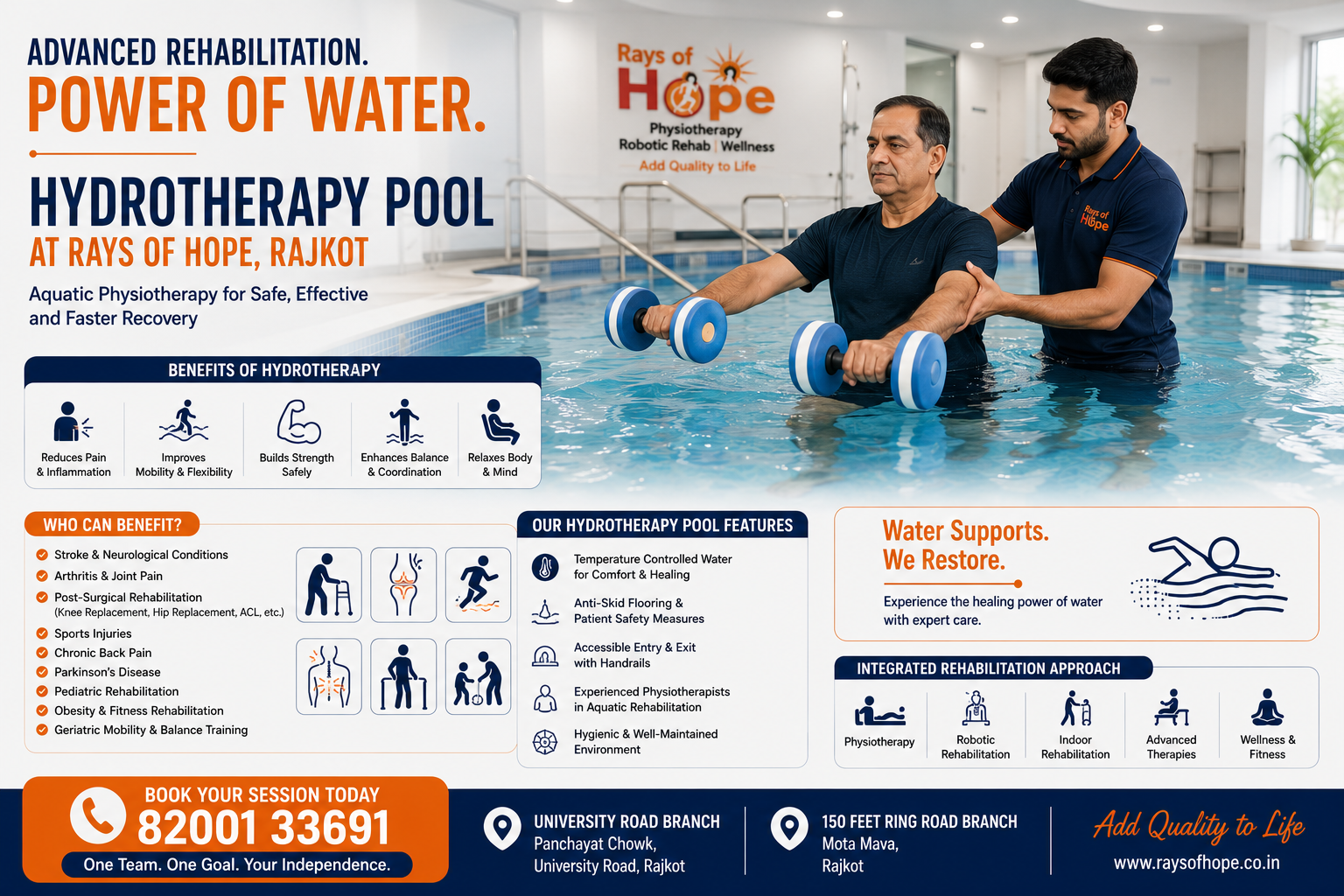
Hydrotherapy Pool in Rajkot: Benefits, Uses & Role of Aquatic Physiotherapy in Rehabilitation
Water can create a unique rehabilitation environment. The buoyancy of water reduces the effective load on the body, while water resistance can be used to develop strength and controlled movement.
Hydrotherapy, also known as aquatic therapy, is a form of rehabilitation in which therapeutic exercises are performed in water under appropriate professional supervision.
For people who find land-based exercise difficult because of pain, weakness, reduced balance or limited mobility, aquatic rehabilitation can sometimes provide an alternative environment in which movement can be practised more comfortably.
At Rays of Hope Physiotherapy, Robotic Rehabilitation & Wellness Center, Rajkot, hydrotherapy can complement conventional physiotherapy and rehabilitation as part of an individualized treatment program.
What Is Hydrotherapy?
Hydrotherapy is the therapeutic use of water to assist rehabilitation.
The properties of water can provide several useful effects:
💧 Buoyancy
Water supports part of the body's weight, reducing loading on joints during appropriate exercises.
💧 Water Resistance
Moving through water creates resistance, which can be used to progressively challenge muscles.
💧 Hydrostatic Pressure
Water pressure around the body may influence swelling and provide sensory input during movement.
💧 Warm Water Environment
When appropriately controlled, warm water may help relaxation and make movement more comfortable for some patients.
The exact benefits depend on water temperature, depth, exercise selection and the patient's medical condition.
Who Can Benefit From Hydrotherapy?
Hydrotherapy may be considered for patients with a variety of rehabilitation needs.
🦴 Orthopaedic Conditions
It may be useful as part of rehabilitation for:
- Knee osteoarthritis
- Hip osteoarthritis
- Joint stiffness
- Post-fracture rehabilitation
- Post-operative rehabilitation
- Joint replacement rehabilitation
- Chronic musculoskeletal conditions
🧠 Neurological Rehabilitation
Aquatic therapy may complement land-based neurorehabilitation for selected patients with:
- Stroke
- Parkinson's disease
- Multiple sclerosis
- Spinal cord injury
- Cerebral palsy
- Balance and mobility problems
- Neurological weakness
Water can provide an environment where supported movement and balance activities can be practised according to the patient's capabilities.
Hydrotherapy After Stroke
Stroke can cause:
- Weakness
- Poor balance
- Difficulty standing
- Difficulty walking
- Reduced coordination
- Muscle stiffness
- Reduced confidence
For selected stroke survivors, aquatic therapy may provide an opportunity to practise movement with additional environmental support.
Possible rehabilitation goals may include:
- Weight shifting
- Trunk control
- Supported standing
- Lower-limb movement
- Balance activities
- Walking preparation
- Functional strengthening
However, hydrotherapy does not replace neuro physiotherapy. It should be integrated into a broader rehabilitation program.
Hydrotherapy for Knee Pain
People with knee pain may find certain land-based exercises uncomfortable because of weight-bearing.
Water can reduce effective loading and allow selected movements to be practised with greater support.
A hydrotherapy program may include:
- Walking in water
- Knee mobility exercises
- Supported squats
- Leg strengthening
- Balance exercises
- Functional movement training
The exercises should be selected according to the patient's diagnosis and tolerance.
Hydrotherapy for Arthritis
For people with arthritis, movement can sometimes become uncomfortable because of joint pain and stiffness.
Aquatic exercise may provide a lower-impact environment for physical activity.
A rehabilitation program may focus on:
Mobility → Strength → Balance → Endurance → Functional Activity
Exercise selection should be individualized rather than assuming that every arthritis patient requires the same aquatic program.
Hydrotherapy After Joint Replacement
After procedures such as:
- Total Knee Replacement
- Total Hip Replacement
- Selected other orthopaedic surgeries
rehabilitation focuses on progressively restoring:
- Range of motion
- Strength
- Walking
- Balance
- Functional independence
Hydrotherapy may be incorporated at an appropriate stage when the surgical wound is healed and the treating medical team considers aquatic exercise safe.
Hydrotherapy for Parkinson's Disease
People with Parkinson's disease may experience:
- Balance difficulties
- Slowness of movement
- Reduced mobility
- Muscle stiffness
- Difficulty walking
Aquatic rehabilitation may provide another environment for practising movement, balance and functional activities.
However, patients with Parkinson's disease require individualized assessment because falls, fatigue and other factors can influence pool safety.
Hydrotherapy for Children
Aquatic therapy may also be considered for selected children with neurological or developmental conditions.
Potential goals may include:
- Improving movement
- Developing balance
- Strengthening
- Coordination
- Motor skill development
- Confidence in movement
For pediatric rehabilitation, pool activities should be age-appropriate, closely supervised and individually planned.
Hydrotherapy for Sports Rehabilitation
Athletes may use aquatic rehabilitation during selected phases of recovery.
It can provide an environment for:
- Low-impact conditioning
- Mobility training
- Strengthening
- Balance
- Running preparation
- Cardiovascular conditioning
As recovery progresses, rehabilitation generally transitions from water-based exercises toward the specific demands of the athlete's sport.
Hydrotherapy vs Conventional Physiotherapy
Hydrotherapy and land-based physiotherapy should not be viewed as competing treatments.
They can complement each other.
| Land-Based Physiotherapy | Hydrotherapy |
|---|---|
| Weight-bearing exercises | Reduced effective loading |
| Gym strengthening | Water resistance |
| Gait training | Supported movement |
| Balance exercises | Aquatic balance challenges |
| Functional training | Water-based functional exercises |
| Sports-specific training | Low-impact conditioning |
The most appropriate combination depends on the patient's condition and rehabilitation goals.
How Does a Hydrotherapy Session Work?
A typical session may include:
1. Assessment
The physiotherapist evaluates:
- Mobility
- Strength
- Balance
- Pain
- Functional limitations
- Medical history
2. Goal Setting
Specific goals are established.
For example:
Improve walking
Increase knee mobility
Improve balance
Increase endurance
3. Water-Based Exercise
The therapist selects appropriate exercises according to the patient's ability.
4. Progressive Training
Resistance, repetitions, depth, speed or complexity may be modified as the patient improves.
5. Functional Integration
Progress made in the pool is transferred to land-based activities wherever appropriate.
Hydrotherapy Is More Than Swimming
A common misconception is that hydrotherapy means simply swimming.
It doesn't.
Hydrotherapy is therapeutic exercise performed in water, not recreational swimming.
A patient may not need to know how to swim to participate in an appropriately designed aquatic rehabilitation program.
Exercises can be performed:
- Standing
- Walking
- Holding pool supports
- Using flotation equipment
- With therapist assistance
- At different water depths
The program depends on the patient's functional ability.
Is Hydrotherapy Safe for Everyone?
No.
Hydrotherapy is not automatically suitable for every patient.
A professional assessment is important, particularly for patients with:
- Significant cardiac conditions
- Uncontrolled seizures
- Open wounds
- Certain infections
- Severe respiratory problems
- Significant incontinence
- Severe medical instability
- Severe fear of water
- Significant cognitive or behavioral difficulties affecting safety
The treating healthcare team should determine whether aquatic rehabilitation is appropriate.
Hydrotherapy & Safety
Safety is especially important for patients with neurological or mobility impairments.
A rehabilitation pool should have appropriate:
- Entry and exit arrangements
- Supervision
- Water monitoring
- Hygiene protocols
- Emergency procedures
- Patient screening
- Therapist assistance when required
Patients should never enter a therapeutic pool without appropriate assessment and supervision when their condition creates a safety risk.
Hydrotherapy + Multidisciplinary Rehabilitation
At Rays of Hope, aquatic rehabilitation can form one part of a broader rehabilitation ecosystem.
Depending on the patient's requirements, rehabilitation may involve:
🧠 Neuro Physiotherapy
For neurological movement and functional recovery.
🦴 Orthopaedic Physiotherapy
For musculoskeletal and post-operative rehabilitation.
🏃 Sports Rehabilitation
For athletes returning to activity.
🤖 Robotic Rehabilitation
Technology-assisted rehabilitation for appropriate patients.
🗣️ Speech & Swallow Rehabilitation
For patients requiring communication or swallowing rehabilitation.
👥 Occupational Therapy
For activities of daily living and functional independence.
🍎 Nutrition Support
When nutritional planning is relevant to the patient's rehabilitation.
🏠 Indoor Rehabilitation
For patients requiring intensive, structured rehabilitation.
This multidisciplinary approach allows different aspects of recovery to be addressed rather than treating only one symptom.
Hydrotherapy + Robotic Rehabilitation
One of the major strengths of modern rehabilitation is the ability to combine different therapeutic environments.
For example:
Robotic Rehabilitation
→ repetitive and technology-assisted movement practice
Land-Based Physiotherapy
→ strength and functional training
Hydrotherapy
→ supported movement and aquatic exercise
Functional Training
→ transfer of gains into everyday activities
The objective is not to use technology or hydrotherapy simply because it is available.
The objective is to select the right tool for the right patient at the right stage of rehabilitation.
How Often Is Hydrotherapy Needed?
There is no universal number of sessions.
Frequency depends on:
- Diagnosis
- Rehabilitation goals
- Medical condition
- Exercise tolerance
- Strength
- Balance
- Pain
- Recovery stage
- Overall rehabilitation program
Some patients may use aquatic therapy as a component of their weekly rehabilitation, while others may require a different combination of therapies.
Hydrotherapy for Weight Management & Fitness
Water-based exercise can also provide an option for people who find high-impact exercise difficult.
It may help facilitate:
- Low-impact cardiovascular activity
- Movement
- Conditioning
- Mobility
- General fitness
For people with obesity, arthritis or reduced mobility, aquatic exercise may sometimes be easier to tolerate than certain land-based activities.
However, hydrotherapy should not be presented as a standalone weight-loss treatment. Long-term health improvement generally requires a comprehensive approach involving physical activity, nutrition and lifestyle management.
Who Should Not Start Hydrotherapy Without Assessment?
Patients should seek professional clearance or assessment when they have:
- Recent surgery
- Significant neurological impairment
- Severe balance problems
- Uncontrolled medical conditions
- Significant heart or respiratory problems
- Open wounds
- Active infections
- Severe weakness
- Recent serious injury
Safety comes before exercise.
Why Choose Rays of Hope for Hydrotherapy in Rajkot?
At Rays of Hope Physiotherapy, Robotic Rehabilitation & Wellness Center, aquatic rehabilitation can be integrated with our broader physiotherapy and rehabilitation services.
Our rehabilitation ecosystem includes:
✔ Hydrotherapy / Aquatic Rehabilitation
✔ Neuro Physiotherapy
✔ Orthopaedic Physiotherapy
✔ Sports Rehabilitation
✔ Pediatric Rehabilitation
✔ Robotic Rehabilitation
✔ Gait & Balance Training
✔ Indoor Rehabilitation
✔ Multidisciplinary Rehabilitation
✔ Wellness & Fitness Programs
Our philosophy is to select rehabilitation interventions according to the patient's condition, functional goals and stage of recovery.
Hydrotherapy in Rajkot: A New Dimension of Rehabilitation
Traditional physiotherapy remains the foundation of rehabilitation.
But modern rehabilitation increasingly provides patients with multiple environments in which to practise movement.
A hydrotherapy pool can provide:
Support
Resistance
Movement
Confidence
Exercise
Functional Training
For appropriately selected patients, this can become a valuable component of a comprehensive rehabilitation program.
Frequently Asked Questions
Is hydrotherapy the same as swimming?
No. Hydrotherapy is therapeutic exercise performed in water under an appropriately designed rehabilitation program.
Can a non-swimmer do hydrotherapy?
Swimming ability is not necessarily required. Exercises can be performed in supported and controlled environments depending on the patient's abilities and pool setup.
Is hydrotherapy useful after stroke?
It may be useful for selected patients as an adjunct to conventional neurological rehabilitation, particularly for movement, balance and conditioning.
Can hydrotherapy help knee arthritis?
Aquatic exercise can provide a lower-impact environment for exercise and may help improve mobility and physical function in appropriate patients.
Can hydrotherapy be done after knee replacement?
It may be incorporated at the appropriate stage, but the surgical wound must be appropriately healed and the treating medical team should consider aquatic therapy safe.
Is hydrotherapy suitable for children?
Selected children may benefit, but pediatric aquatic rehabilitation requires age-appropriate programming and appropriate supervision.
Does hydrotherapy replace physiotherapy?
No. Hydrotherapy is one component of rehabilitation and should complement clinical assessment and other appropriate therapies.
Final Takeaway
Hydrotherapy is not simply exercising in a swimming pool.
It is a structured rehabilitation approach that uses the properties of water to support movement, exercise and functional recovery.
For appropriately selected patients, it can complement:
Physiotherapy + Exercise Therapy + Functional Training + Robotic Rehabilitation + Multidisciplinary Care
At Rays of Hope Physiotherapy, Robotic Rehabilitation & Wellness Center, Rajkot, our goal is to provide patients with a comprehensive rehabilitation environment where different therapies can work together toward one objective:
Better Movement. Greater Independence. Better Quality of Life.
Rays of Hope
Physiotherapy – Robotic Rehab – Wellness
📍 University Road Branch – Panchayat Chowk, Rajkot
📍 150 Feet Ring Road Branch – Mota Mava, Rajkot
📞 +91 82001 33691
Add Quality to Life
SEO Details
SEO Title:
Hydrotherapy Pool in Rajkot | Aquatic Physiotherapy & Rehabilitation
Meta Description:
Discover hydrotherapy and aquatic physiotherapy in Rajkot. Learn about hydrotherapy benefits for stroke, arthritis, knee pain, sports injuries and neurological rehabilitation.
Primary Keyword:
Hydrotherapy Pool in Rajkot
Secondary Keywords:
- Hydrotherapy in Rajkot
- Aquatic Physiotherapy Rajkot
- Aquatic Therapy Rajkot
- Hydrotherapy Rehabilitation Rajkot
- Hydrotherapy for Stroke Rajkot
- Hydrotherapy for Knee Pain Rajkot
- Hydrotherapy for Arthritis Rajkot
- Hydrotherapy for Parkinson's Rajkot
- Pediatric Hydrotherapy Rajkot
- Water Therapy Rajkot
- Aquatic Rehabilitation Center Rajkot
- Physiotherapy Pool Rajkot
Suggested URL:
/hydrotherapy-pool-in-rajkot/
Suggested Featured Image Alt Text:
Hydrotherapy pool and aquatic physiotherapy rehabilitation in Rajkot
Internal Links:
Physiotherapy in Rajkot → Neuro Rehabilitation → Robotic Rehabilitation → Knee Pain Physiotherapy → Stroke Rehabilitation → Indoor Rehabilitation → Sports Physiotherapy → Contact Us